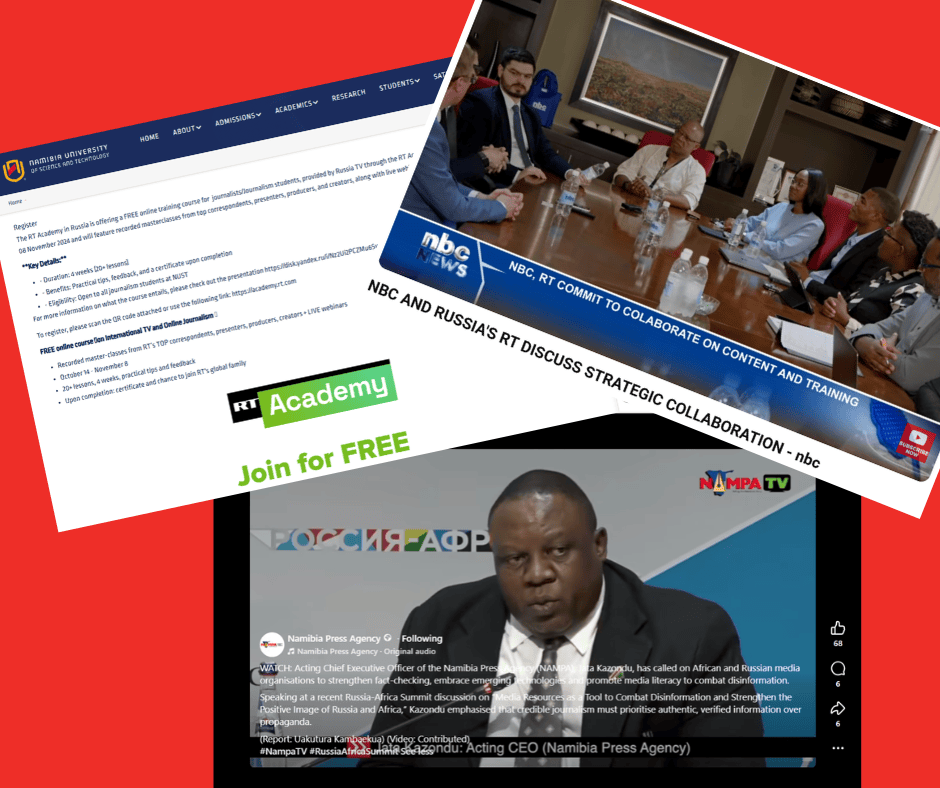
IMAGE: Namibia’s state media sector has long standing relations with Russian media entities / Namibia Fact Check
Large sections of Namibia’s news media are in danger of being completely ensnared in Russian influence campaigns
Without a hint of irony, the acting chief executive of the state-owned Namibia Press Agency (NAMPA), Jata Kazondu, on a Russian stage recently “called on African and Russian media organisations to strengthen fact-checking, embrace emerging technologies and promote media literacy to combat disinformation”.
Kazondu was a panellist in a discussion titled ‘Media Resources as a Tool to Combat Disinformation and Strengthen the Positive Image of Russia and Africa’, at the recent Russia-Africa Summit and Economic and Humanitarian Forum, held in Moscow on 28-29 October 2026.
Kazondu’s statements reflect a by-now unsurprising reality in Namibia: State-owned media takes its friendship cues from the government of the ruling Swapo Party which was supported by the Soviet Union during the Liberation Struggle era.
Barely a week after Kazondu’s comments at the summit, the last bastion of independent Russian journalism, Novaya Gazeta, shut down in the face of mounting state censorship and repression.
Influencing relations
In March 2026, the Namibian Broadcasting Corporation (NBC), the largest media entity in Namibia, and Russian state-media entity RT committed to “collaborate on content and training”.
This was not a first, for the NBC has been broadcasting RT content, but now the relationship appears to be moving over to one where content will be created for Namibian audiences with RT assistance.
RT has also provided free online training to Namibian journalists and journalism students over recent years. RT’s training was even promoted on the Namibia University of Science and Technology (NUST) website.
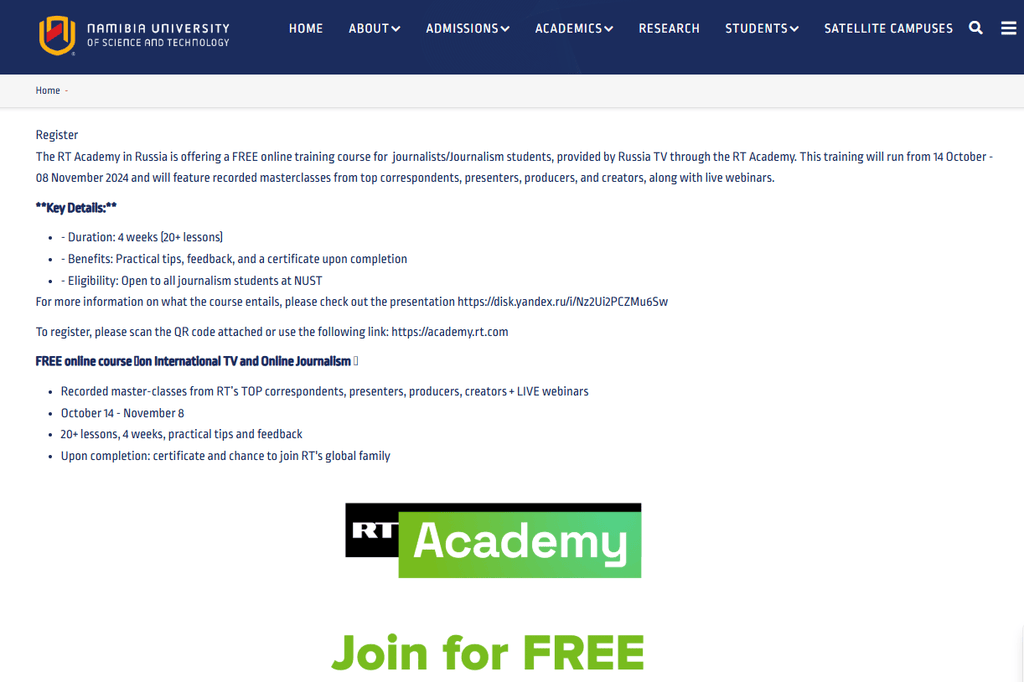
The RT training for journalists as promoted on the website of the Namibia University of Science and Technology (NUST).
According to Meduza, the online news website founded by exiled Russian journalists, the RT training is nothing but an attempt to “shape a new generation of journalists trained to amplify the Kremlin’s narrative”, by turning African journalists into “Kremlin mouthpieces”.
Aside from these information influence initiatives, as was illustrated in the third article in the ‘Russian Shadows’ series, Namibian journalists, not just those with state-owned media, have been treated to all-expenses paid junkets by Russian entities, such as Headspring Investments / Rosatom, over the years, but without being able to record anything for reporting purposes at visited Russian sites.
The in-situ leaching graphic
Talking of Headspring Investments / Rosatom, at the end of October 2025, the exact same graphic spread explaining in-situ leaching uranium recovery was published by all three of Namibia’s largest national daily newspapers: The Namibian, Namibian Sun and state-owned New Era.
What was noticeable about the two-page spread was that it appeared on news or editorial pages and that it was unattributed. None of the newspapers made it clear to their readers that the spread was advertorial or paid-for-content, but was published as if it were news content when it clearly was not.
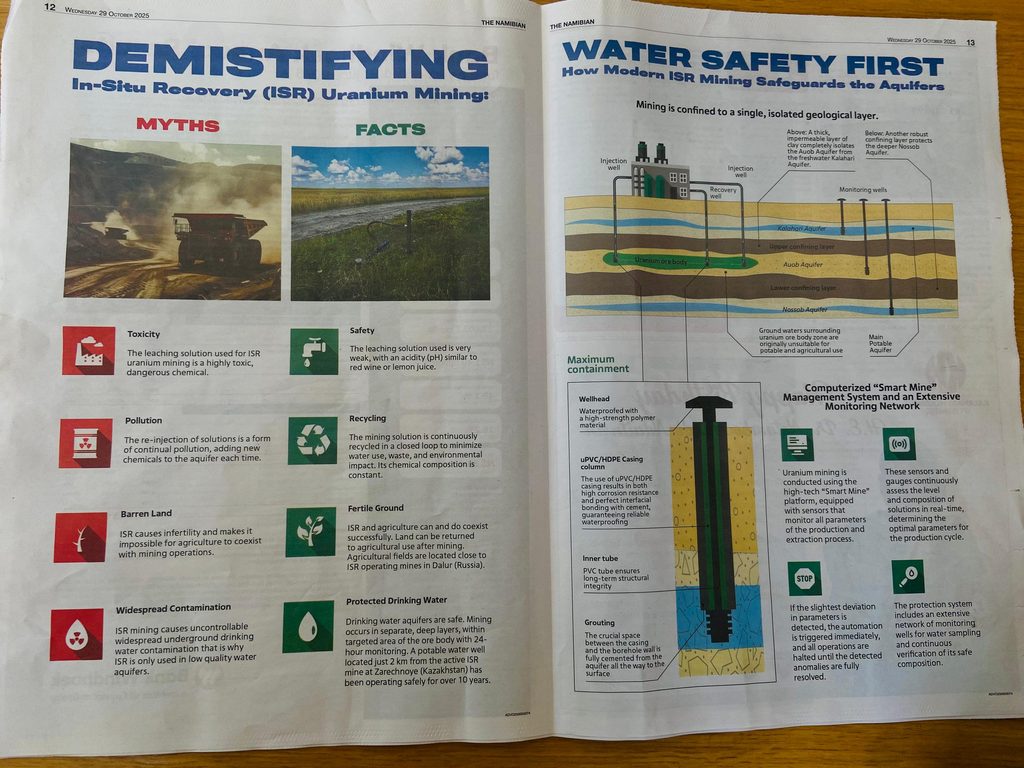
The double-spread in-situ leaching recovery explainer as it appeared on the news pages of The Namibian newspaper on 29 October 2025.
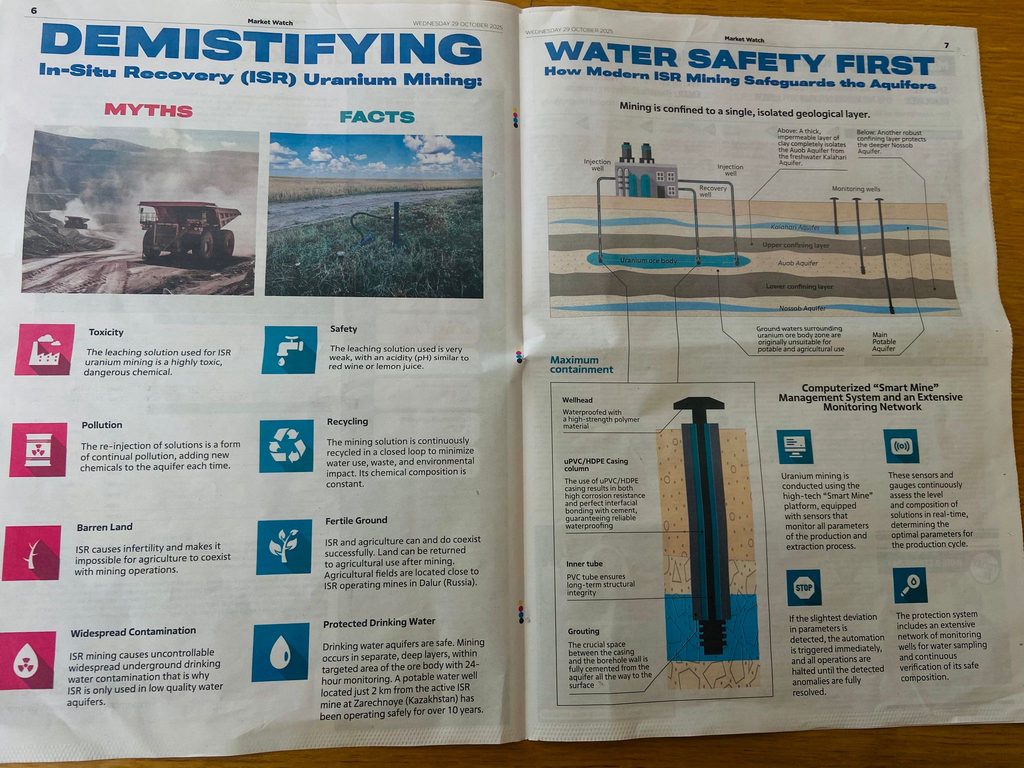
The double-spread in-situ leaching recovery explainer as it appeared on the news pages of Namibian Sun newspaper on 29 October 2025.
These are just some examples of how Russian influence appears to be growing on Namibia’s troubled and struggling news media landscape. The warning signs for the Namibian news media sector and news audiences are clear.