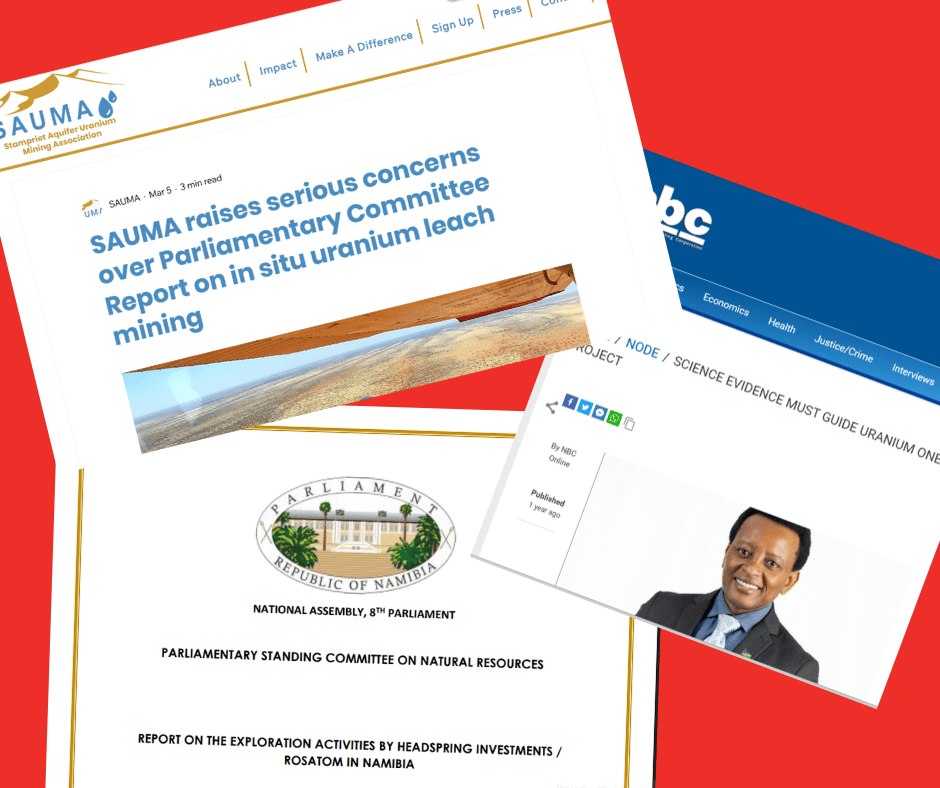
IMAGE: Screenshots of online articles and posts related to the proposed uranium mining in eastern Namibia / Namibia Fact Check
Contesting narratives around Russian uranium exploration in eastern Namibia suggest information manipulation and interference at play
The proposed in-situ leaching method of uranium extraction proposed by Headspring Investments (Pty) Ltd in the Leonardville area of Namibia’s eastern Omaheke Region has for long been at the heart of contesting narratives.
Headspring Investments is a subsidiary of Uranium One Group, which is the international arm of Russia’s state-owned uranium miner, Rosatom.
Headspring Investments has been pursuing uranium exploration and development in the Omaheke Region since 2011, and for the last 15 years the project has been dogged by opposition from local farmers, activists and Namibian environmentalists who have maintained that the in-situ leaching method of uranium extraction will contaminate the major groundwater source in the area, the Stampriet Transboundary Aquifer System (STAS).
FIMI at work
Delegations to Russia
In early 2026, Headspring Investments / Rosatom took a Namibian delegation to visit its in-situ leach operation at the Dalur mine in Russia. According to reports, the delegation consisted of “Namibian farmers, a journalist and employees”.
This was just the latest delegation, as Headspring Investments / Rosatom has been taking Namibian delegations to visit its Russia and Kazakhstan operations for years, with mixed results.
Following the 2026 delegation’s visit to the Dalur mine, one of the delegates, an Omaheke farmer named Dylan Mukoroli has penned a number of opinion-editorial articles (see here, here and here) that have expressed support for Headspring Investments’ in-situ leaching method, and echoing the company’s positions on aspects such as employment creation.
One of the tactics of an information influence campaign is to enable a perceived credible local actor to communicate specific messages and drive relevant narratives via traditional and social media in order to demonstrate and canvas support for an issue or initiative.
Influencing politicians and parliament
Headspring Investments / Rosatom also appears to have been successful in bringing the National Assembly’s standing committee on natural resources to its side.
In 2025 the parliamentary committee, led by Tobie Aupindi of the ruling Swapo Party, undertook to investigate the issues around the Russian company’s proposed mining site. The committee compiled a report that was tabled in parliament earlier this year.
What is striking about the report is that it appears to be solely based on the perspectives and assertions of the Russian company, following engagements in both Namibia and Russia, and expresses support for the company’s proposed uranium extraction method and for the company to be granted approval to go ahead with mining.
In the wake of the report, committee chairperson Aupindi has gone as far as stating that the potential benefits of the Headspring Investments / Rosatom investment were being “sabotaged or wasted”.
In response to the report becoming public earlier this year, the Stampriet Aquifer Uranium Mining Association (SAUMA), consisting of local farmers and community members in the Leonardville area, issued a statement that read:
“SAUMA was taken by surprise by the Committee’s findings. Despite our efforts to engage with the Standing Committee, SAUMA was not consulted at any stage of the process. Instead, exclusive engagement appears to have been afforded to Headspring Investments, a foreign-owned company. This raises fundamental questions about the transparency, balance, and credibility of the Standing Committee. The stance taken by the Committee in its report and in presenting only one side of the issue is highly irresponsible.”
Similarly, an analysis of the committee report by independent research firm Survey Warehouse found the following:
“Overall, the study concludes that the parliamentary report does not adequately satisfy the standards expected of a credible oversight instrument in a contested groundwater-sensitive ISR case. The implication is not simply that the report appears biased in tone, but that it may provide an insufficiently balanced and legally grounded basis for parliamentary judgement.”
In effect, the SAUMA and Survey Warehouse statements and analysis accused the parliamentary committee of having been co-opted by Headspring Investments / Rosatom.
In a more recent development, a report issued by the International Atomic Energy Agency (IAEA), on behalf of the Namibian government, found that Headspring Investments / Rosatom’s claim that its proposed in-situ leaching uranium extraction method would be safe and not contaminate groundwater sources remained unproven. These findings align with what local activists and environmentalists have been saying for years.
Also worth noting is that reporting from earlier this year indicates that in-situ leaching uranium extraction has left behind long lingering harm in parts of eastern Europe where it has been implemented under the Soviet Union.