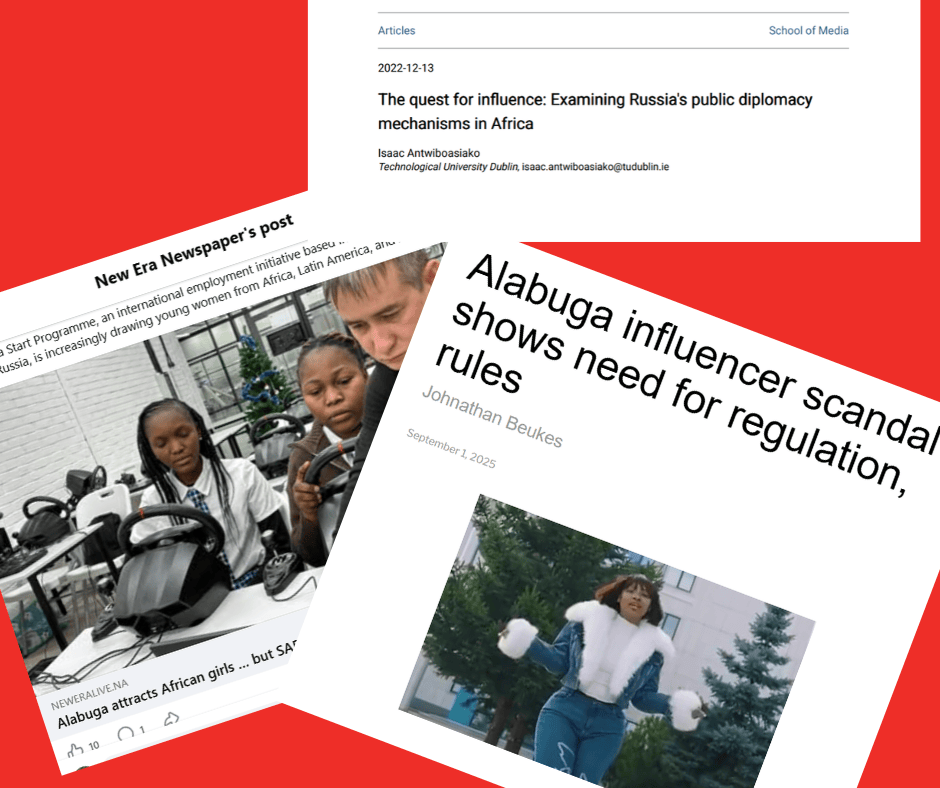
IMAGE: The Alabuga Start programme controversy suggested Russian FIMI activities on Namibia’s media landscape / Namibia Fact Check
Russia’s influence activities are not just limited to information and news landscapes, but are also advanced through soft power outreach and enticements
NOTE: This article was updated on 24 November 2026 to introduce information related to the Alabuga controversy.
Russia’s public diplomacy has “two main narratives”: “The first narrative is based on Russia being the protector of the ‘free world’, by countering the imposition of Western-style democracy and the removal of sovereign governments, also by the West, and the second narrative is based on Russia protecting traditional family values.”
This is from a 2022 article, titled ‘The quest for influence: Examining Russia’s public diplomacy mechanisms in Africa’, in the South African Journal of International Affairs, which argues that many African countries “welcome these two narratives as convincing”.
The article notes that Russia primarily uses five “mechanisms” to “improve global perceptions of Russia” and to influence African publics.
The five “mechanisms” surfaced by the article are:
- Historical ties;
- Educational aid;
- Health aid;
- International broadcasting and digital diplomacy; and
- Exploiting anti-Western sentiments.
All of these “mechanisms” of soft power influence are noticeably deployed by Russia in its public diplomacy in Namibia. Examples of where these mechanism become vehicles for information manipulation and interference are presented below.
Historical ties
According to the 2022 journal article, understanding “historical links helps one grasp the affinity many African states have for Russia today”. This is because while “Russian official foreign aid programmes in Africa during the Cold War were far smaller than those of the West, its support of African liberation movements was far greater”.
Namibia’s ruling party, the Swapo Party, was a beneficiary of such “support of African liberation movements”, a fact its leaders continuously tout.
Just recently, as the Namibian president was set to jet off to the Russia-Africa Summit, of 28-29 October 2026, the Namibian Presidency issued a statement reaffirming the relationship between the two countries.
The statement reads:
“Namibia and Russia enjoy longstanding relations founded on mutual respect and cooperation. The two countries established diplomatic relations on 21 March 1990, the day Namibia gained independence. These ties are rooted in historical solidarity, including the support extended by the former Soviet Union during Namibia’s liberation struggle.”
Similarly, Russian officials, politicians and diplomats also continuously point to historical ties as underpinning warm relations between the two countries. Case in point are statements made by Russian ambassador to Namibia, Dmitry Lobach, in an interview published by the African Initiative, to mark Namibia’s 26 August Heroes Day this year.
Lobach was quoted saying:
“The strong bonds of friendship and mutual understanding between Russia and Namibia, forged during the Namibian people’s struggle for liberation, serve as a solid foundation for the development of bilateral cooperation today.”
It is because of these historical ties that it would seem plausible that the ruling Swapo Party would approach actors affiliated to the Russian state and Russian state security services and encourage and enable them to engage in foreign information manipulation and interference (FIMI), as alleged in reporting by Forbidden Stories in early 2026.
The Alabuga Start controversy
Throughout 2025 and into 2026 a Russia-related controversy made headlines across southern Africa, including in Namibia.
The Alabuga Start programme, a scheme related to the Alabuga Special Economic Zone in Russia’s Tatarstan, was promoted across African societies as a job recruitment and training initiative for especially young African women.
However, reporting from across the continent and internationally alleged that the Alabuga Start programme was nothing more than an attempt to traffick young Africans into forced labour in Russia’s military industrial complex in support of that country’s war in the Ukraine.
The Alabuga Start scheme was also promoted to Namibians, and there was a visible difference between how state-owned and private media reported on the scheme and the controversies surrounding it.
In early January 2026, in the wake of much reporting about the controversies surrounding the Alabuga Start scheme across southern Africa and beyond throughout 2025, the state-owned New Era newspaper, carried a long article that almost entirely ignored the allegations of trafficking and forced labour, and reported the scheme as simply an “international employment initiative” and opportunity for young African women. A mere few sentences at the end of the article skimmed lightly over the controversies surrounding the Russian initiative. Notably, the report makes it clear that the New Era reporter who wrote the article had been taken to Russia to view what was happening at the Alabuga Special Economic Zone and within the Alabuga Start programme, including meeting up with four Namibian young women who were part of the initiative. The article also quotes the Russian hosts as labeling the allegations and reports of human trafficking and forced labour in support of Russia’s war effort as ‘Western propaganda’. (NOTE: Unfortunately the New Era report referenced here is now behind a paywall)
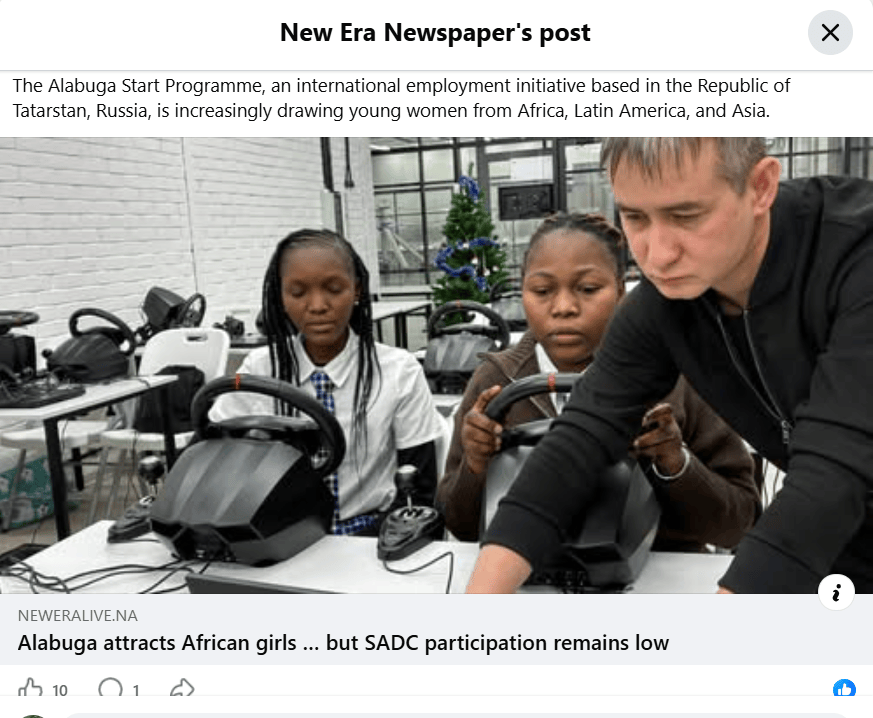
Screenshot of the Facebook post that links to the New Era report that cast the Alabuga Start scheme in an almost positive light, while skimming over the allegations against the initiative.
In contrast, outlets like The Namibian (here and here) and online news site The Issue (here and here), provided critical coverage of the Alabuga Start scheme before and after the New Era report, while the Namibian government pleaded ignorance on the issue of Namibian young women being involved in the controversial Russian initiative and largely remained silent.
The New Era report suggested Russian information manipulation and interference, in the wake of all the critical and negative coverage of the Alabuga Start programme, and that the Namibian state and state-owned media enabled Russian FIMI. The Namibian government’s hesitation to officially confront the Alabuga Start controversy, which is how other African governments have responded, probably once again speaks to not upsetting close historical ties with Russia.